why am i always tired as a mom
Why Am I Always Tired as a Mom? The Answer Is in Your Week
Rest isn't helping and you can't tell why. Here's how to find what in your week is draining you, with a simple two-week check you can start today.


In this article
You went to bed earlier. You cut the sugar, mostly. You got through the week by telling yourself the weekend would fix it, and then the weekend was a birthday party, two games and a grocery run, and Monday you felt exactly as tired as you did on Friday. Some weeks you're fine. Then one week you're snapping at everyone and running on empty, and you can't tell what was different.
If you've typed "why am I always tired as a mom" into your phone more than once, here's the honest answer: for a lot of women, the tiredness rest doesn't fix has a lot to do with what the weeks are made of. Not one big thing. A handful of small, repeated drains that nobody sees, you included. The good news is that you can find them, and you don't need a new routine to do it.
Why am I always tired as a mom when I'm not doing anything different?
Because the part that wears you down mostly isn't the doing. It's the tracking. Who needs a ride, which form is due, whether your mom took her pills, what's for dinner, who's upset with whom. A Harris Poll for Skylight found parents spend 30.4 hours a week planning and coordinating family schedules and household tasks, close to a second job that never shows up on a calendar.
That load doesn't switch off when you sit down. So you can have a "quiet" Saturday and still come out of it flat, because your head spent the whole day running the next week. That's why "I'm not even doing that much" and "I'm exhausted" can both be true. If this sounds familiar, our guide to the mental load goes deeper on where it comes from.
The kind of tired a weekend doesn't fix
In a study of midlife working women in the Netherlands, one woman put it in a single line: "I counted down to the weekend so I could rest, but I didn't get any rest." That's the trap. A weekend is only restful if it's different from the week, and for most moms it's the same job with different chores.
So more sleep helps a little, and then the same week happens again. You aren't failing at rest. You're resting inside the thing that drains you.
Why you can't tell what's draining you
Your memory is bad at this, and it's not your fault. When you look back on a week, you remember the worst day and a general fog. You don't remember that the hard days were the ones with the long call with your mom, or the week the carpool fell apart, or the stretch where you stopped going for your walk.
The drains are small enough to dismiss one at a time. The things that used to help disappear the same way: quietly, with no decision. One day you notice you haven't walked in a month and you can't say when it stopped.
A sleep score or an emoji mood app doesn't solve this either. It gives you a number with no story. What you need is your own week, in your own words, lined up side by side.
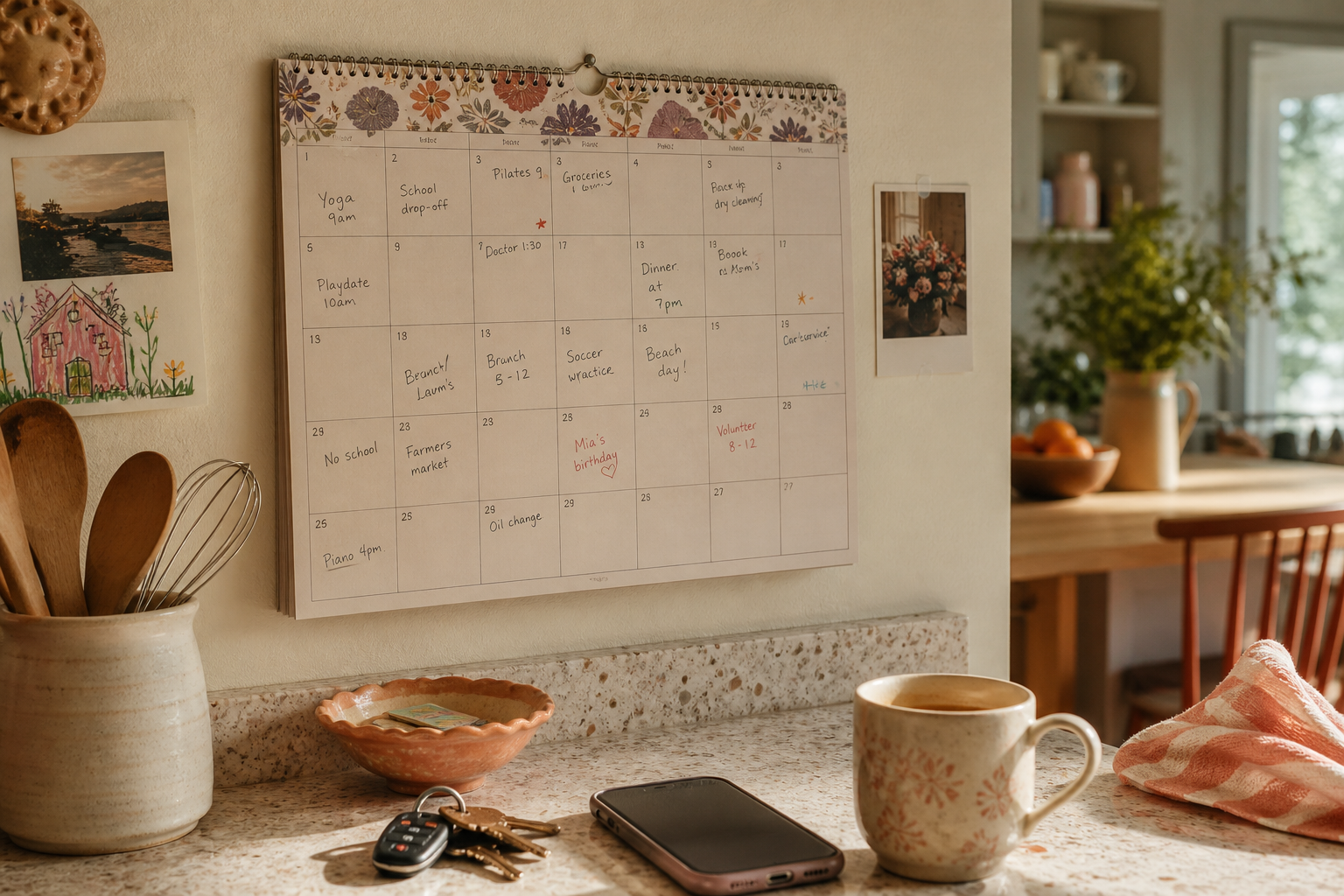
How to find what's draining you: a two-week check
This works with a notes app, a voice memo or the back of an envelope. It only asks you to notice, not to change anything yet.
- Ask three questions each day. What took the most out of me today? What gave me anything back? What did I skip that usually helps?
- Give the day a rough score. Fine, okay or wiped. Don't overthink it.
- Write down the specifics. "Mom's call ran long" beats "busy day". "Fight about screens" beats "stressful".
- Line up the wiped days. After two weeks, put them side by side. What do they share? Who was there, what was on the calendar, what got skipped?
- Pick one drain and one lift. Shrink one drain (shorter, moved, shared or dropped) and protect one thing that helps, even in a bad week.
 zzSkipped walkFeeling drained?
Quick quiz · About a minute
Stress quiz: what's draining you?
Quick questions about your week, not your health. Get your result and a plan for this week.
Free. No email needed. Your result shows straight away.
Drains most moms never count
A few drains are easy to miss. Watch for these:
- Being the one who anticipates. Remembering the dentist, the size the kids are in now, the gift for the teacher. Every item is small. Together they never stop.
- Caring for a parent. The calls, the appointments, the worry in between. It often lands on the same days every week, which makes it easy to spot once you look.
- Decisions nobody else makes. Dinner, plans, who goes where. Being the default decider is tiring in a way that's hard to explain.
- The same argument on a loop. If one conflict keeps coming up, it costs you twice: during it, and while you brace for the next one.
- The lift that quietly vanished. The walk, the friend you used to call, the hobby. Losing a lift can drain you as much as adding a load.

Where Ripple fits
The check above works. The catch is that it asks you to keep it up for two weeks, which is hard when you're already this tired.
Ripple is built to take the keeping-up off you. You talk, whenever you get a second: in the car, walking the dog, folding laundry. Say how your day went, messy and in any order. Ripple writes it down and turns what you said into tasks with the dates you mentioned, checks off the habits you track when you mention them, scores your mood, and over the weeks shows you what keeps coming up and what drains you versus what lifts you. A weekly report pulls the week together, and the Life Matrix tracks the main areas of your life over time, so you can see where things are slipping.
You say
"Rough one. Mom's call went long again and I never got out for my walk. I need to book her eye appointment for the 14th and sign the field trip form by Friday. I was short with the kids at dinner and I hate that."
Ripple catches
- Book Mom's eye appointment (the 14th)
- Sign the field trip form (Friday)
- Mood: rough
It doesn't name a cause, and it isn't a health app. It shows you your own weeks so you can decide what to change. Patterns take a few weeks of talking to show up, and the more you talk, the clearer they get. If you're ready to see what your weeks are made of, start a free week or download the app; you can cancel anytime.
If you'd rather not track your week by hand, here's how Ripple shows what's draining you.
Frequently asked questions
Is it normal to always be tired as a mom?
It's common, and you're far from the only one. Common doesn't mean you have to accept it, though. If rest isn't helping, look at what your weeks are made of.
Why doesn't the weekend help?
For most moms the weekend is the same job with different chores: errands, games, parties, prep for Monday. Rest only works when it's different from the week. Look for one stretch of the weekend that belongs to you, even a short one.
I've already seen a doctor. What now?
Look at your weeks. Track what took the most out of you each day, what helped and what you skipped, for two weeks. The wiped days usually have something in common, and that's something you can work with.
How long until I see a pattern?
Two weeks of honest notes is usually enough to spot one or two repeats. In Ripple, the patterns get clearer the more you talk, so give it a few weeks before judging.
Related reading
Say it once. Ripple remembers.
Talk it out and Ripple pulls out your tasks, tracks your habits and mood, and shows you your patterns each week.
7-day free trial · Cancel anytime