who takes care of mom when she's sick
Who Takes Care of Mom When She's Sick? (Usually, Still Mom)
When you're sick and still running the house, the problem isn't laziness. Here's why moms stay "on" even while ill, and what actually helps lighten the load.


In this article
You're lying on the couch with a fever, and you're still texting the pediatrician's office because nobody else knows the portal login. You've got a sinus infection or the flu or whatever is going around, and somewhere between the chills you remembered that the permission slip is due tomorrow and the dog's heartworm pill was supposed to happen three days ago. You typed "who takes care of mom when she's sick" into your phone not because you wanted a philosophical answer. You wanted someone to take over. And the honest, short answer is: almost nobody does. Not because the people around you don't care, but because the system that runs your household lives inside your head, and there's no backup copy.
That's the real problem. It's not that you need soup and a nap (though yes, you do). It's that even flat on your back, your brain won't stop dispatching. The water bill. Thursday's dentist appointment. Mom's prescription refill. The birthday gift that hasn't shipped. You are the project manager of a operation that never pauses, and "being sick" just means you're managing it from a horizontal position.
Why "just ask for help" doesn't work when you're sick
People love to say this. "Just tell him what you need!" As if the asking isn't its own job. When you're sick, you're supposed to be recovering. Instead you're triaging: what can wait, what can't, what will he actually follow through on, and what will you have to re-do anyway. A report from the American Psychological Association has consistently found that women report higher stress levels than men, in part because of this invisible coordination labor. It doesn't stop when your temperature hits 101.
The asking is work. Delegating is work. Checking that it got done is work. And when you're sick, you have roughly zero capacity for any of it, so you just do the things yourself, badly, from the couch, and then feel guilty for snapping at the kids about something that isn't even about them.
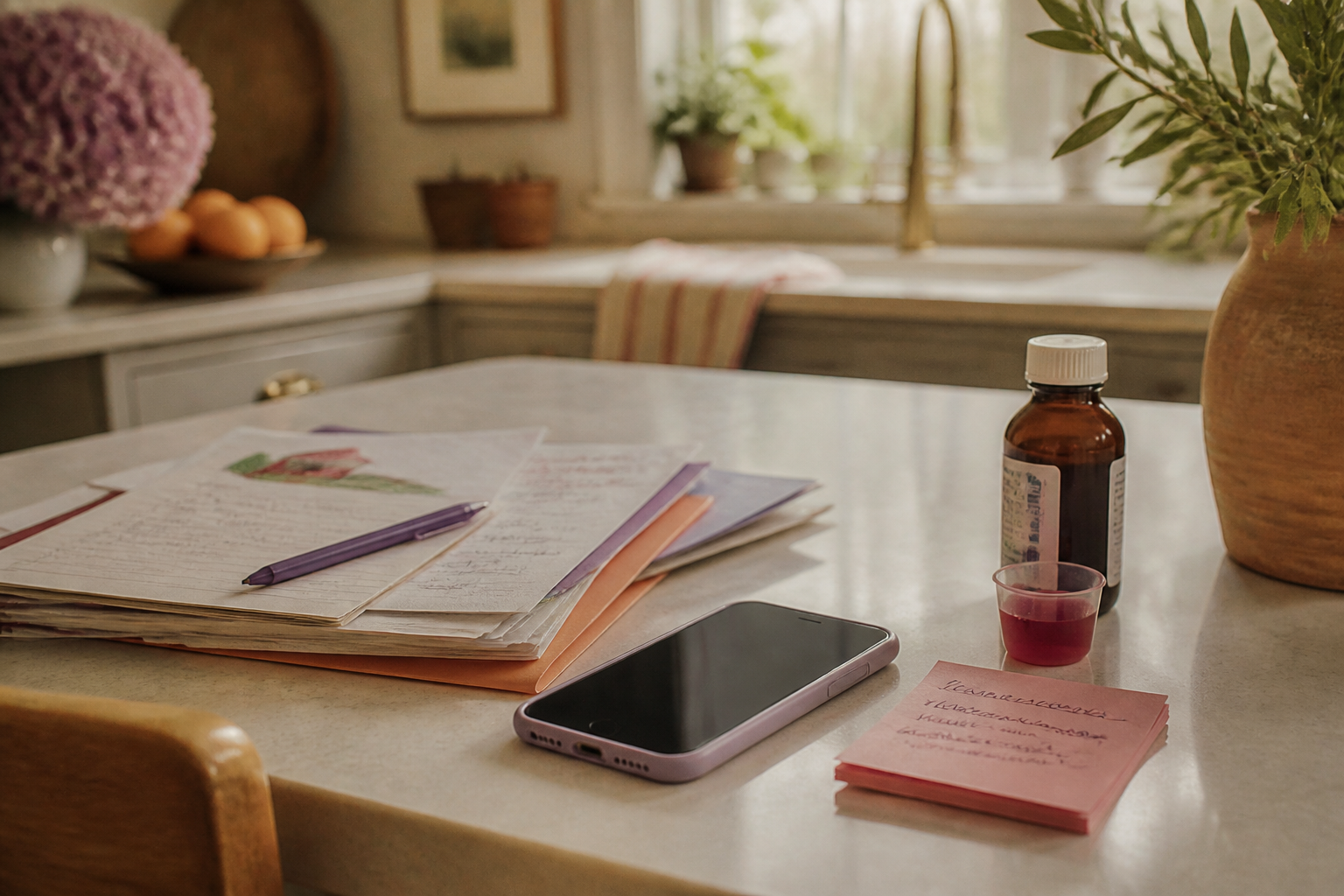
Mom takes care of everyone, but who takes care of mom?
This question circulates on social media every few months, usually over a video of a mom crying in a parked car. It resonates because it names something real. But most of the responses stay at the emotional level: "You deserve rest." "You matter too." Those are true and also completely unhelpful when you're staring at eleven notes on your phone and none of them are organized.
Here's what I've noticed talking to women who deal with this: the tiredness isn't primarily from doing. It's from tracking. You could handle any five of the things on your list today. The part that's drowning you is holding all thirty of them in your head simultaneously, plus the ones you haven't remembered yet, plus the ones on the shared calendar he doesn't check.
Research from the Journal of Research on Adolescence and broader family studies literature shows that mothers consistently perform more "cognitive labor" (anticipating needs, planning, monitoring) than fathers, even in households where physical tasks are split evenly. The invisible work is real, measurable, and exhausting.
The tiredness isn't primarily from doing. It's from tracking.
What actually helps (today, while you're still sick)
I'm not going to tell you to "set boundaries" or "have a conversation with your partner about equitable distribution of household management." You're sick. You need things that take almost no effort. Here's what works.
- Get it out of your head and into one place. Not eleven notes. Not a text to yourself, a sticky note on the counter, and a mental note you'll forget. One place. Open your phone's notes app, a Google Doc, a voice memo, whatever. Say or type every single thing that's living rent-free in your head right now. Don't organize it. Just get it out. The relief is immediate, even if you don't act on any of it today.
- Put dates on the things that have dates. "Permission slip" means nothing in a list. "Permission slip, due Friday" is actionable. Go through your dump and add the when. Now it's not something you have to remember. It's written down.
- Pick three things someone else can do without your supervision. Not "things he could theoretically do if I explain them." Things where the outcome doesn't matter that much. Ordering pizza for dinner. Throwing in a load of laundry. Dropping the library books in the return slot. Hand those off with zero follow-up. If the pizza has pineapple on it, fine. You're sick.
- Let the rest wait. The birthday gift can ship tomorrow. The water bill has a grace period. Mom's appointment can be booked when you can sit upright. Give yourself permission to be a mediocre project manager for 48 hours. The household will survive.

 Dentist ThuCall MomWater billPermission slipFeeling overloaded?
Quick quiz · About a minute
Mental load quiz: how much are you carrying?
Quick questions about how much you keep track of. Get your result and a plan for this week.
Free. No email needed. Your result shows straight away.
The deeper problem: your head is the only system
Getting through this week while sick is one thing. But this will happen again. Next cold, next stomach bug, next time you just hit a wall. And the same scramble will repeat because the fundamental issue hasn't changed: everything still lives in your head.
Most tools don't fix this because most tools need you to maintain them. Planners need writing. Apps need typing and categorizing. Shared calendars need the other person to actually open them. You've tried these. They worked for about nine days, and then you were back to mental notes and scattered reminders and the low hum of "what am I forgetting."
What would actually help is something where you just say it, out loud, once, and it lands somewhere with the date attached. No organizing. No formatting. No maintaining a system on top of running a household.
That's roughly what Ripple does. You talk, whenever you have a free moment (in the car, between meetings, while you're heating up leftovers), and say whatever is on your mind. "Mom's cardiologist appointment needs to be rescheduled to after the 15th. The water bill is due Friday. I told Jake's teacher I'd send in the allergy form by Wednesday. I haven't exercised in two weeks and I feel like garbage." Ripple pulls out the tasks with the dates you mentioned, tracks the goals you keep circling back to, and scores your mood over time. Your stuff shows up on the list too, not just everyone else's. Start a free week or download the app; you can cancel anytime.
You say
"I need to reschedule Mom's cardiology appointment to sometime after the 15th. Water bill is due Friday. Jake's allergy form has to go to the school by Wednesday. I haven't worked out in two weeks and I'm annoyed at myself about it."
Ripple catches
- Reschedule Mom's cardiology appointment (after the 15th)
- Pay water bill (Friday)
- Send Jake's allergy form to school (Wednesday)
- Mood: frustrated, self-critical
- Habit: exercise (noted gap)
- Pattern: her own needs consistently listed last
Who will take care of mom? Start with letting something take care of the list.
Nobody is coming to lift the entire mental load off your shoulders. That's the hard truth. Your partner can do more tasks, sure. But the tracking, the anticipating, the remembering: that part has been yours for years, and redistributing it is a slow process that won't happen while you have a 102-degree fever.
What can happen today is smaller and more concrete: stop carrying it all silently. Say it out loud. Get it written down, with dates, in one place. Let your head be a little quieter. That's not a cure for an unfair division of labor. But it's the difference between drowning and floating, and floating is enough to get through this week.
According to a widely cited study published in the American Sociological Review, the cognitive dimension of housework (keeping track of what needs to happen and when) is the most unequally divided and the least visible. Naming it is the first step. Getting it out of your head is the second.
You don't have to become a different person or adopt a new "system." You just need fewer things living only in your brain. That's it.
FAQ
Who takes care of the mother when she is sick?
In most households, the answer is: she does, at reduced capacity, while still managing everyone else's needs. The mental load of a household doesn't have a pause button. The most practical thing you can do is externalize what's in your head (write it down, say it out loud, get it into one list) so your brain can actually rest. For more on the mental load specifically, see our guide to the mental load.
Why do moms keep going when they're sick?
Because the household's "operating system" is stored in her memory. If she stops tracking, things fall through the cracks: missed appointments, forgotten forms, late bills. It's not martyrdom. It's that nobody else has the information, and transferring it takes more energy than just doing it herself. The fix isn't willpower. It's getting the information out of her head and into a place others (or she herself, later) can access.
How can I reduce my mental load when I'm overwhelmed?
Start with a full brain dump: say or write every single thing you're tracking right now, no matter how small. Add dates where they exist. Then pick three items someone else can handle without your oversight. The goal isn't to get organized. It's to stop holding everything in active memory. A brain dump guide walks through this step by step.
Is "mental load" a real thing or just complaining?
It's well-documented in sociology and psychology research. The cognitive labor of anticipating, planning, and monitoring household needs is measurable, disproportionately performed by women, and linked to higher stress and burnout. It's not complaining. It's describing an invisible job that doesn't show up on any to-do list.
Related reading you might find useful:
Say it once. Ripple remembers.
Talk it out and Ripple pulls out your tasks, tracks your habits and mood, and shows you your patterns each week.
7-day free trial · Cancel anytime