ADHD Voice Recording for Task Management
Written to-do lists fail ADHD brains. Voice recording removes the friction between thinking and capturing. Learn how to use voice for ADHD task management.
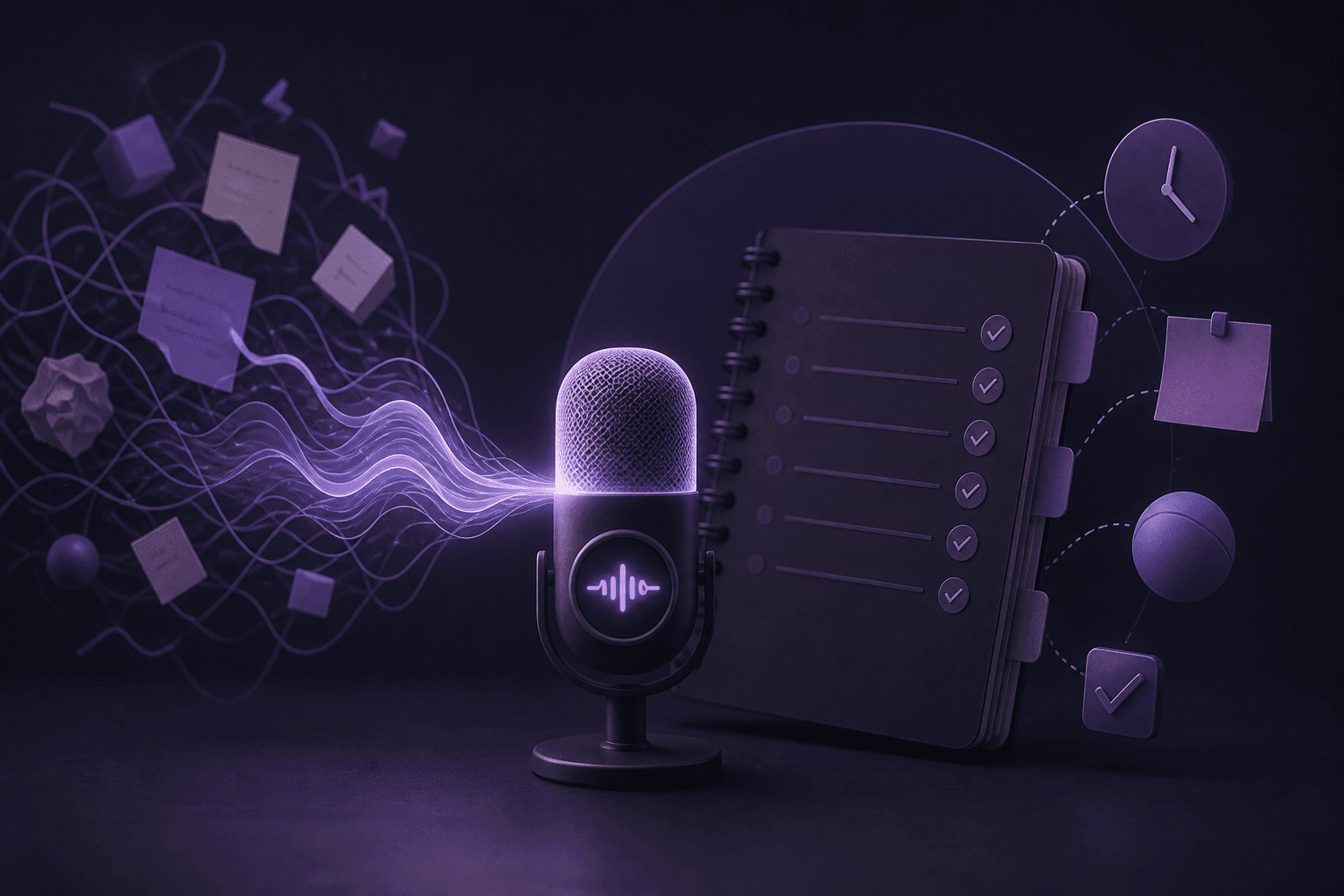
You had four things to do today. You knew them clearly at 8:47 a.m. while brushing your teeth. By 9:15, you were at your desk, and two of them were gone. Not done, just gone from your memory. If this sounds familiar, ADHD voice recording task management might be the most useful shift you make this year. Not because it's flashy, but because it removes the exact friction point where ADHD brains lose tasks: the gap between thinking and capturing.
This isn't about apps or productivity systems. It's about the neuroscience of why writing fails many people with ADHD and why speaking works.
Why traditional to-do lists fail the ADHD brain
The standard advice is simple: write everything down. Buy a planner. Use a task app. Check things off. The problem isn't that people with ADHD don't know this advice. The problem is that the advice assumes a working memory buffer that ADHD specifically impairs.
ADHD is fundamentally a disorder of executive function. According to CHADD (Children and Adults with Attention Deficit/Hyperactivity Disorder), core deficits include working memory, task initiation, and organization. Those are the exact three skills required to maintain a written to-do list. You need to hold the task in mind, initiate the act of writing, and organize it into a system. That's three executive function demands just to record one task.
Written to-do lists also create a secondary problem: they become a wall of text. For ADHD brains that struggle with prioritization, a long written list triggers overwhelm rather than clarity. Research from the American Psychiatric Association notes that difficulty organizing tasks and activities is a core diagnostic criterion for ADHD. The tool meant to help with organization demands the very skill that's impaired.
Here's the pattern most people with ADHD recognize: you start a to-do list on Monday. By Wednesday, you haven't looked at it. By Friday, you've started a new one on a different app or a different sticky note. The system collapses not because you're lazy, but because the system has too much friction for your specific brain.
Why speaking reduces friction to nearly zero
Speaking is cognitively cheaper than writing. That's not an opinion. It's a measurable fact.
| Method | Approx. speed (words per minute) | Steps to start | Executive function demand |
|---|---|---|---|
| Speaking (voice recording) | ~150 | Press one button, talk | Very low |
| Typing (phone or laptop) | ~40 | Open app, find field, format | Moderate |
| Handwriting (notebook) | ~13 | Find notebook, find page, write | High |
When you're trying to capture a thought before it vanishes, speed matters enormously. But speed isn't the full story. Voice recording also removes the task-initiation barrier. Opening a notebook or app, finding the right page, deciding on formatting: these are micro-decisions that drain executive function. With voice, you press one button and talk. The thought goes from your brain to a recording in under two seconds.
For ADHD specifically, this matters because of what researchers call the "intention-action gap." You intend to capture the task. You know you should. But the steps between intention and action are where ADHD creates drag. Voice recording compresses those steps into essentially one: speak.
There's another benefit that gets overlooked. When you speak your to-do list, you naturally add context. Instead of writing "call dentist," you'll say something like, "I need to call the dentist about that filling that's been bugging me. The number is on the fridge, and I should do it before noon because they close early on Thursdays." That context becomes incredibly useful later. Written to-do lists strip context. Voice preserves it.
ADHD voice recording task management in practice
So what does this actually look like day to day? Here's a realistic workflow.
The verbal capture
Once or twice a day, whenever tasks are piling up in your head, you open a voice recorder and say everything that's on your mind. Tasks, worries, half-formed ideas, reminders. The goal isn't to be organized. The goal is to get it out of your head before your working memory drops it.
This works especially well during transition moments: getting in the car, finishing a meeting, walking to the kitchen after a stretch of work. These are the moments when ADHD brains are most likely to be holding tasks that haven't been captured yet.
Extraction over organization
The old model says: organize your thoughts, then write them down neatly. The ADHD-friendly model flips this. Dump everything messily. Let something else extract the structure. This is where AI becomes genuinely useful, not as a gimmick, but as a compensatory tool that handles the executive function step you'd otherwise skip.
A good voice-to-task system listens to your messy verbal capture and pulls out the actual action items. "I need to email Sarah about the project deadline" becomes a discrete task. "I keep forgetting to refill my prescription" becomes a reminder. You don't have to do the sorting. You just have to talk.
Pattern recognition over willpower
One of the most underrated aspects of consistent voice recording is what it reveals over time. If you record verbal captures regularly for a few weeks, patterns emerge that you'd never spot in the moment. Maybe you consistently mention the same undone task for eight days straight, a signal that something about that task is creating avoidance. Maybe you notice your energy and focus collapse every day around 2 p.m. Maybe certain goals keep appearing and disappearing.
For ADHD brains, this kind of pattern detection is almost impossible to do internally. External systems that track and reflect your own words back to you become a mirror for your executive function blind spots.
What the research says about externalization and ADHD
Dr. Russell Barkley, one of the foremost ADHD researchers in the world, has spent decades arguing that ADHD is best managed through externalization: moving internal mental processes into the physical environment. Timers, visual reminders, written cues, and voice recordings all serve this purpose. The principle is straightforward: if your brain can't hold it reliably, put it somewhere your brain can access it reliably.
Voice recording is arguably the lowest-friction form of externalization available. It requires no fine motor skill, no formatting decisions, no organizational schema. You talk. The information exists outside your head. Done.
ADDitude Magazine, a leading resource for ADHD management strategies, consistently recommends reducing the number of steps between thought and action as a core ADHD coping strategy. Voice recording is the logical endpoint of that recommendation: the fewest possible steps.
Common objections (and honest answers)
"I'll never go back and listen to my recordings"
Fair point. Raw voice recordings are hard to review, especially if you have ADHD. That's why voice recording alone isn't enough. You need automatic transcription and extraction. If you're recording into your phone's default voice memo app, you're right, you probably won't review it. The value comes when something processes that recording into text, tasks, and patterns without requiring you to do the tedious work.
"I can't talk out loud at work"
You don't have to. A quick verbal capture in your car, in the bathroom, or on a walk works fine. You can whisper. You can do it in a stairwell. Most people find a window at least once during their day. And unlike a written journal, which demands sustained sitting and focus, a voice entry can happen while you're moving.
"Isn't this just voice memos with extra steps?"
Voice memos capture audio. That's it. The difference with a voice-to-task system is what happens after the recording: automatic extraction of tasks, tracking of recurring themes, mood detection, and periodic reports that synthesize days or weeks of entries. The recording is the input. The value is in the processing.
Making it stick: the ADHD-friendly habit stack
Starting any new habit with ADHD is hard. Here's a realistic approach rather than an idealistic one.
Anchor it to something you already do. Habit stacking, attaching a new behavior to an existing one, works well for ADHD because it removes the task-initiation demand. "After I start my car in the morning, I do a quick verbal capture" is more sustainable than "I will journal every day at 7 a.m."
Keep the bar absurdly low. Say whatever comes to mind. Not ten minutes of reflection. Not a structured review. Just talk about what's in your head. On days when you have more to say, you'll naturally go longer. On days when you don't, even a brief entry is still valuable.
Don't aim for streaks. The streak mentality ("I must do this every single day or I've failed") is toxic for ADHD. Missing a day isn't failure. Three entries in a week is infinitely more useful than zero entries in a week. The data still accumulates. The patterns still emerge.
Let the review come to you. Don't rely on yourself to review your tasks and patterns. Use a system that sends you a summary. A weekly report that arrives automatically is far more ADHD-friendly than a system that requires you to remember to check in.
A note on Ripple
Ripple is a voice journaling app built around this exact idea. You talk through what's on your mind, and Ripple pulls out tasks, tracks goals you keep mentioning, detects mood, and surfaces patterns in a weekly report. It's a mirror, not a coach: it reflects what you said so you can see what your brain keeps circling. There's a 7-day free trial, no credit card required, at $4.99/month or $39.99/year. Worth trying if the friction of written systems has burned you out. Learn more here.
FAQ
Can voice recording replace a written to-do list for someone with ADHD?
For many people, yes. Written lists demand working memory, task initiation, and organization, three skills specifically impaired by ADHD. Voice recording compresses task capture into a single step: speaking. The key is pairing voice recording with automatic transcription and task extraction so you don't have to go back and listen to raw audio.
What is the best time of day for ADHD voice task capture?
There's no single best time. The most effective approach is to record during transition moments: after a meeting, getting in the car, finishing lunch. These are the moments when tasks are fresh but at risk of being forgotten. Some people do a morning capture to plan and an afternoon one to recapture what shifted. Experiment and notice when your working memory feels most overloaded.
Does voice journaling help with ADHD emotional regulation?
Yes. Verbalizing emotions and frustrations has a well-documented calming effect. For ADHD brains that experience emotional dysregulation, a quick voice entry can serve as both a task capture tool and a pressure valve. Over time, mood patterns become visible, which helps you anticipate and manage emotional cycles rather than being blindsided by them.
How is voice-to-task different from regular voice memos?
Voice memos just store audio. A voice-to-task system processes the recording: it transcribes your words, extracts discrete action items, tracks recurring themes, and can flag patterns across days or weeks. The recording is the input. The value is in the automatic processing that saves you from the executive function work of reviewing and organizing raw audio.
Say it once. Ripple remembers.
Talk through your day and Ripple pulls out the tasks, tracks your goals, and shows you your patterns each week. Free for 7 days.
No credit card required · Cancel anytime